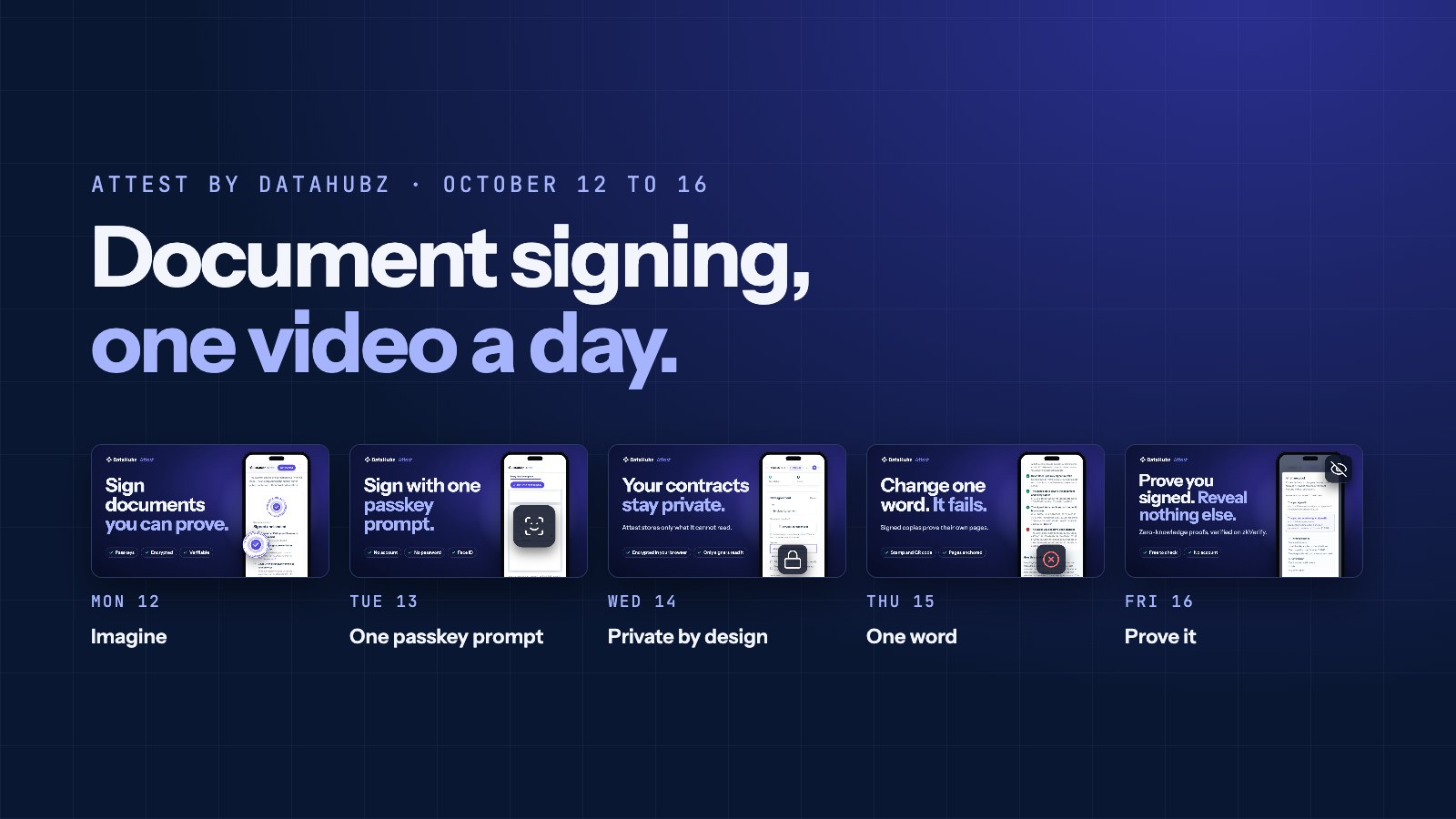
Day three of our document signing series is about privacy. Today's video shows what happens to a contract the moment you upload it to Attest.
What a contract contains
Agreements hold some of the most sensitive information a business has: prices, margins, plans, names, commitments and the terms of relationships that competitors would like to know. When you send a contract through a signing service, you usually hand all of it to that service in readable form.
That creates a risk you did not choose: the service, its staff, its subcontractors and anyone who breaches it can read your contracts.
Encrypted before it leaves your browser
Attest encrypts each document in the sender's browser before it is uploaded. What reaches our servers is ciphertext. We store only data we cannot read.
The document can be opened only by the people who sign it, on their own devices. Not by us, and not by anyone who gains access to our storage.
Private terms, public evidence
Privacy usually comes at the cost of verifiability. If no one can read the document, how can anyone confirm it was signed?
Attest separates the two. What is anchored on Horizen is the agreement's fingerprint, never its content. A fingerprint reveals nothing about the text, but any change to the document produces a different one. So:
- The terms stay between the parties.
- Anyone can still check that the agreement was signed, by whom and when.
- Senders choose whether the certificate is public, or private to the parties, with zero-knowledge proofs, verified on zkVerify, for anyone else who needs evidence.
Why it matters
Encryption at the source removes an entire category of risk. A signing service that cannot read your contracts cannot leak them, misuse them or be compelled to hand over their content.
Try it
Upload a contract and send it for signature. Every account can send two documents for free, with no credit card.